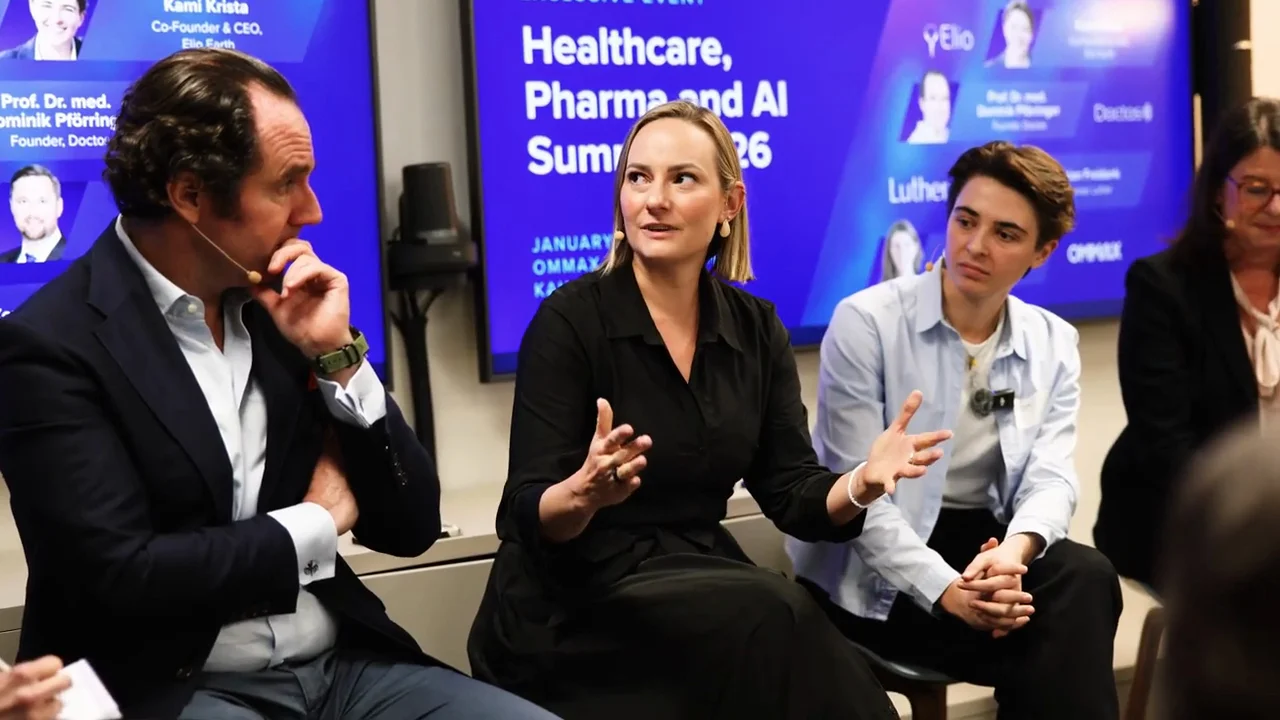
Healthcare, Pharma & AI Summit 2026: Shaping the future of digital health and AI innovation
Healthcare, Pharma & AI Summit 2026
Munich, 15 January 2026 | The healthcare industry is undergoing a profound transformation driven by digitalization, data, and AI innovation. At our Healthcare, Pharma & AI Summit 2026 in collaboration with Luther Law, executives, investors, and healthcare leaders came together to explore how digital transformation, emerging technologies, and data-driven solutions are reshaping patient care, operational efficiency, and long-term value creation.
The summit provided a platform for strategic dialogue and practical insights, helping industry leaders tackle key challenges such as workforce shortages, regulatory complexity, and patient engagement while discovering new opportunities for sustainable growth and innovation in healthcare and life sciences.
Our speakers & panelists
- Dr. Vanessa Conin-Ohnsorge (Managing Partner, IDV Bodenheim)
- Luisa Wasilewski (Founder & Managing Director, Pulsewave Digital)
- Kami Krista (Co-Founder & CEO, Elio Earth)
- Prof. Dr. med. Dominik Pförringer (Founder, Doctos)
- Adrian Freidank (Lawyer Counsel, Luther)
- Dr. Anja Konhäuser (Founding Partner, OMMAX)

Key insights from the event: Infrastructure is improving, value creation is next
2026 marks the moment when healthcare must move from infrastructure to value creation. After more than a decade of political commitment, regulatory effort, and large-scale investment, the digital foundations of the healthcare system are more and more in place. Electronic patient records (ePA), the national healthcare telematics infrastructure, and e-prescriptions have been rolled out. The pipes have been built. What now matters is whether these foundations are finally used to create measurable outcomes.
This shift was at the center of discussions at the event, with a clear conclusion emerging: the defining challenge is no longer access to technology; it is the ability to redesign systems to unlock value at scale.
Dr. Anja Konhäuser, Founding Partner of OMMAX, added:
“The future of healthcare will not be decided by software, but by the courage to redesign the system it runs on.”
From building infrastructure to creating capability
The electronic patient record, the telematics infrastructure, e-prescriptions: These achievements were necessary, complex, and hard-won, but they are not value-creating on their own. At the same time, AI is entering healthcare with enormous momentum. With the launch of ChatGPT Health, patients are already using AI to interpret medical information, prepare medical appointments, and track health-related patterns, often outside traditional healthcare systems and faster than established structures can respond. In healthcare organizations, AI has gained leadership attention, appeared in strategy decks, and become a recurring boardroom topic. Yet in everyday clinical reality, adoption remained limited. Beyond pilots and innovation labs, scaled impact is still rare. This is not a failure; it reflects a system in transition.

Why 2026 marks a structural shift
From late 2026 onwards, a fundamental change begins. ePA data will hopefully start flowing into the Research Data Center Health (FDZ), and we expect Germany to integrate into the European Health Data Space (EHDS). For the first time, fragmented health data becomes more and more usable, linkable, and population-scale.
Together with nationwide digital identity, maturing ePA and e-prescription infrastructure, increasing regulatory clarity for digital and AI-based solutions, and a market ready to scale rather than experiment, these forces converge. This convergence has the chance to fundamentally change the economics of healthcare. Last but not least, this shift is reinforced by unprecedented public investment. With the launch of the €50bn Hospital Transformation Fund in 2026, capital is explicitly tied to structural change.
We move from isolated digital solutions to systemic capability: the ability of the system to learn, adapt, and improve at scale. The numbers reflect this shift: the German digital health market alone is expected to grow at nearly 16% CAGR through 2034, reaching close to $95bn in projected volume.
Healthcare as a value chain and why AI changes its logic
Healthcare is not a single moment of care. It is a continuous value chain that starts long before a patient enters the system and continues long after treatment ends. Each step creates value. But historically, these steps have been organized in silos, with different systems, incentives, and data. Digitalization often followed the same logic, optimizing individual steps one by one. This is exactly where the old model breaks. AI does not just improve a single process, it changes the logic of the entire chain. To capture its value, healthcare systems must be redesigned end-to-end. This leads to six requirements healthcare organizations must get right.

Six requirements for successfully using AI in healthcare
1. Digital infrastructure must be operational, not just available
Healthcare systems now largely have digital infrastructure in place. But availability does not equal usability. AI cannot compensate for systems that exist on paper but are not reliably embedded in daily operations. Foundations must be stable, connected, and trusted by users.
2. Data quality and connectivity matter more than model sophistication
AI performance is constrained less by algorithms than by fragmented, inconsistent data. Without connected, well-governed data, organizations create dashboards, not decisions. Even simple AI can deliver value when data foundations are right.
3. AI must reduce workload, not add complexity
Capacity is the scarcest resource in healthcare. In German hospitals, around 35% of nursing capacity and 38% of physician capacity are absorbed by documentation and compliance tasks. AI that does not clearly give time back will not scale.
4. Regulation must be addressed proactively, not waited out
Regulation creates trust, but only if organizations engage with it early. Successful initiatives designed with regulatory requirements in mind start with well-governed use cases and build legal certainty instead of waiting for perfect clarity.
5. Leadership must define value before scaling technology
AI is not an IT project. It is an organizational decision. Leaders must define what value means: outcomes, efficiency, resilience — and align stakeholders around it. This includes accepting that AI systems operate probabilistically, not deterministically.
6. Long-term resilience and sustainability must be built in early
AI will increasingly shape supply chains, resource allocation, and environmental impact. Systems optimized only for short-term performance will weaken over time. Resilience must be designed, not added later.
From digital readiness to systemic leadership
By 2026, digital readiness will be table stakes. Infrastructure is improving a lot. AI tools are accessible. Investment is accelerating. The differentiator will be who embeds AI most effectively into the healthcare value chain.
The infrastructure has been built.
The regulatory foundation has been created.
We are entering the data era.
Now the question is not if the system will change, but who will shape it.
2026 is not the end state. It is the end of the beginning. Organizations that understand this will move from digital projects to systemic leadership. Those who don’t will be optimized — by others.
Curious to learn how OMMAX can support you? Find out more about tech, data, and AI transformation in the healthcare sector.


Discover highlights from the event


Connect with OMMAX to explore event partnership and participation opportunities

Ilaria Sabena
Consultant Marketing Strategy

